



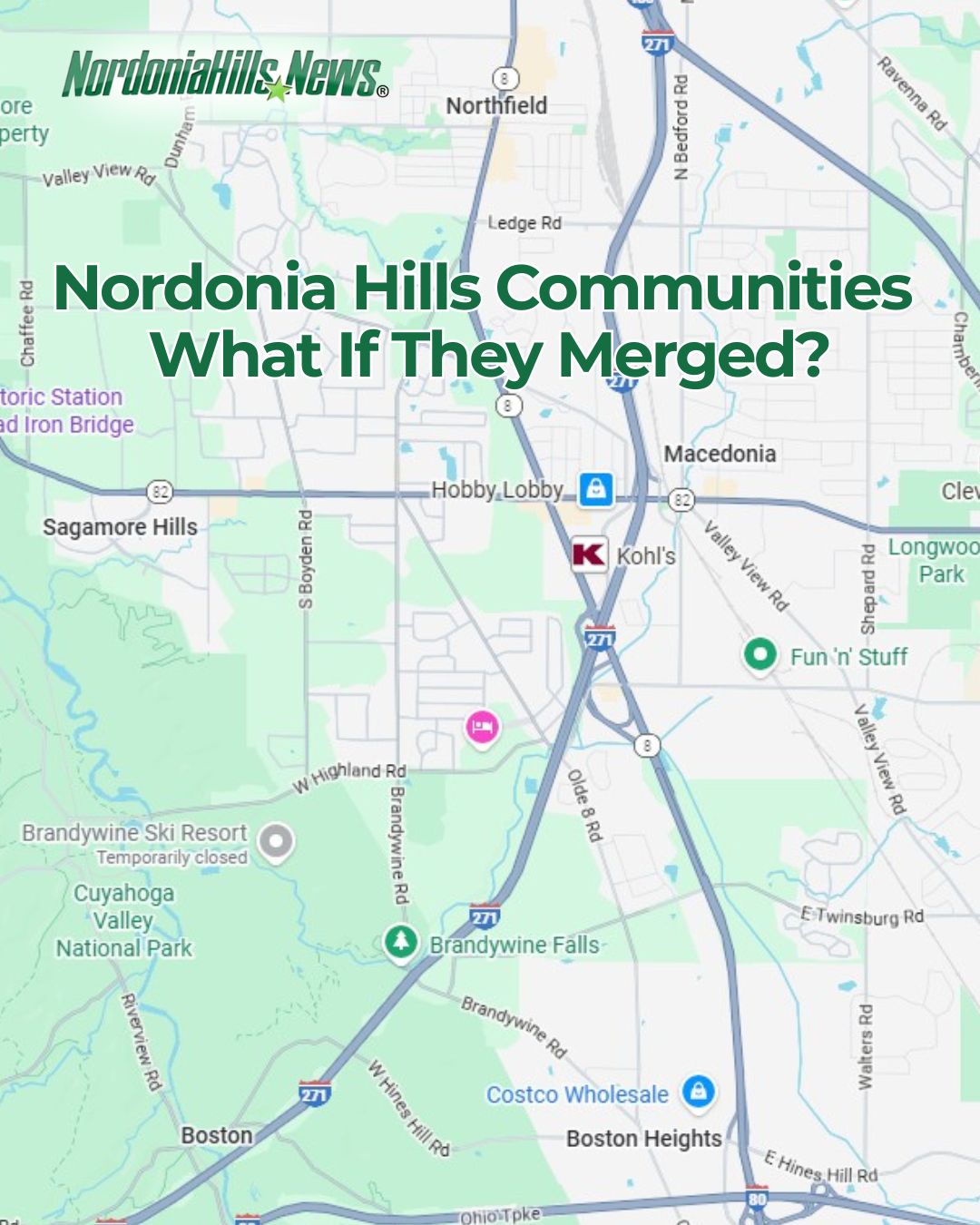
What Ohio’s merger laws mean for Northfield Center, Northfield Village, Sagamore Hills, Macedonia, and Boston Heights
As far as we know, none of our local governments are currently discussing a merger. This article explains what Ohio law allows and explores, as a “what if,” how a Nordonia Hills municipal merger might work and what it would mean for residents and businesses. The focus here is on the practical and political steps — and the confusion the current patchwork of jurisdictions can create. For a deeper look at the two Northfields, read our article from earlier this year: The Tale of the Two Northfields.
The idea of consolidation in the Nordonia Hills area has been discussed informally over the years. For residents, and especially for newcomers or businesses, the current patchwork of jurisdictions can be confusing. Even long-time residents sometimes struggle to differentiate between Northfield Center Township and Northfield Village, often unsure which specific entity provides their services or collects their taxes.









A relatively new state law created a streamlined process for local governments to merge, making it much easier than the older, commission-based method. This raises a question for our area: could this law ever lead to the communities of Northfield Center, Northfield Village, Sagamore Hills, Macedonia, and Boston Heights uniting as a single “City of Nordonia Hills”?
What the Streamlined Merger Law Does
Ohio’s streamlined merger law applies when:








- A city or village wants to merge with another city or village, or with a township
- The governments are contiguous (they share a border)
It’s an alternative to older, slower methods that required citizen-elected commissions and long processes.
Basic steps:
-
Initial Vote by Local Officials
Each council or board of trustees must pass a resolution or ordinance to propose the merger.- Requires a two-thirds vote in each participating city, village, or township.
-
Merger Agreement (120 Days)
Once those resolutions pass, the governments have 120 days to negotiate a merger agreement that covers:- Which governments are merging
- The new boundaries
- The effective date of the merger
- How services, employees, debts, and assets will be handled during the transition
Each council or board then approves the final agreement by a simple majority vote.
-
Voter Approval in Each Community
The merger then goes on the ballot in each affected jurisdiction.- A simple majority of voters in every single community must say yes.
- If even one city, village, or township votes no, the merger does not happen.
-
Effective Date
If approved everywhere, the merger takes effect once the election results are certified.
If a city or village has its own charter with different merger procedures, those charter rules can override parts of this process. Also, this streamlined law does not cover mergers with county governments.
Townships Merging With Each Other
Separately, Ohio law lets two or more townships merge into a single township. That involves:
- Resolutions by township trustees or citizen petitions
- A merger agreement similar in concept to the municipal merger agreement
- Majority voter approval in each township
This is a different path from creating or expanding a city, but it can be one step in a longer-term consolidation.
“Nordonia Hills” Is a School District, not a City
Right now, Nordonia Hills is:
- A school district and regional identity, not a government unit
- Serving Northfield Village, Northfield Center Township, Sagamore Hills Township, the City of Macedonia, and parts of Boston Heights
Legally, you cannot just convert the school district into a city by changing its label. Any “City of Nordonia Hills” would have to be formed by merging existing cities, villages, and townships using state law.
Could Northfield Center and Northfield Village Merge?
Northfield Center Township and Northfield Village are exactly the kind of neighbors the streamlined law was written for:
- One is a township
- One is a village
- They share borders and a community identity
But even if the law makes the process simpler on paper, it would still be a major decision with real-world impacts, such as:
-
Income Tax Differences
- Northfield Center Township does not currently have a municipal income tax.
- Northfield Village does.
A merger would raise difficult questions about how, or whether, to unify tax policy.
-
Representation and Identity
How would residents be represented on a new council or governing body?
Would the combined community keep the “Northfield” name or adopt something new? -
Services and Zoning
Police, fire, road maintenance, zoning rules, development standards, and existing contracts would all need to be aligned or renegotiated.
Even if officials and residents wanted to explore it, a merger would take time, negotiation, and, ultimately, voter approval.
Public Safety: Police and Fire Are Already Semi-Regional
Right now, Nordonia Hills communities already share some services, especially in public safety.
-
Police in Northfield Center
Northfield Center Township does not have its own police department. Instead, it contracts with the Summit County Sheriff’s Office for law enforcement. That means any call for police in the township is handled through the county, not by a local municipal department. -
Fire/EMS in Sagamore Hills and Northfield Center
The Macedonia Fire Department already provides fire and EMS services for:- The City of Macedonia
- Sagamore Hills Township
- Northfield Center Township
These services are provided on a contract basis, with multiple stations positioned across the area.
In other words, some of the “sharing” that a merger might aim to accomplish is already happening informally through contracts. However, a formal consolidation or merger could eventually:
- Put police coverage for Northfield Center under a local municipal police department (for example, a merged city’s police force, whether based on Northfield Village, Macedonia, or a new combined department), rather than the Summit County Sheriff.
- Bring fire, EMS, and police services under one unified city structure, instead of a patchwork of contracts and separate governing bodies.
For residents, that could mean fewer questions about which agency covers what, or which department responds to which side of a boundary line. For officials, it could mean a single governing body overseeing budgets, staffing, and long-term planning for safety services.
Could the Whole Nordonia Hills Area Become One City?
In theory, a single “City of Nordonia Hills” might be created, but it would be complex and would not happen in a single step. It might look something like this:
-
Township Consolidation
Northfield Center Township and Sagamore Hills Township might merge into a larger township. -
Municipal Merger Steps
That larger township could then, in separate actions over time, consider mergers with:- Northfield Village
- The City of Macedonia
- Potentially a defined portion of Boston Heights (if the law and boundary changes allowed it)
-
New City Status and Charter
Once the resulting entity met the population threshold and legal requirements, it could:- Adopt a charter
- Name itself the “City of Nordonia Hills,” or another agreed name
- Spell out how council districts, taxation, services, and departments would be structured
Throughout the entire process, each participating government would retain a kind of “veto power” through:
- Its own elected officials’ votes, and
- Its own residents’ ballot box decisions
There is no mechanism in state law to force these communities to merge against local opposition.
Boston Heights: A Special Case
Boston Heights complicates matters because only part of it lies in the Nordonia Hills school district and it’s tied to multiple districts. Ohio’s merger and boundary-change laws typically operate on whole municipal corporations or townships. Carving out only a portion of Boston Heights to join a new city would likely require annexations, boundary adjustments, or other separate procedures. We discuss all of the school districts that are within Boston Hts. in this article from February The Tale of the Two Northfields.
Why the State Encourages Mergers
In recent years, state leaders have shown interest in:
- Reducing duplicate services across many small governments
- Saving money for both local governments and taxpayers
- Offering financial incentives to communities that voluntarily merge or share services
The streamlined merger law is part of that broader push, but it only works when local officials and voters choose to use it.
Bottom Line for Nordonia Hills
- The legal tools already exist for cities, villages, and townships in the Nordonia Hills area to merge.
- Any move toward a merger would be local and voluntary — driven by resolutions from local governing bodies and majority approval from voters in each community.
- As far as we know, no such merger is currently being discussed by our local governments.
For now, “Nordonia Hills” remains a shared school district and community identity. But the state laws are in place if, at some point in the future, residents and leaders decide they want to explore becoming something more.
