



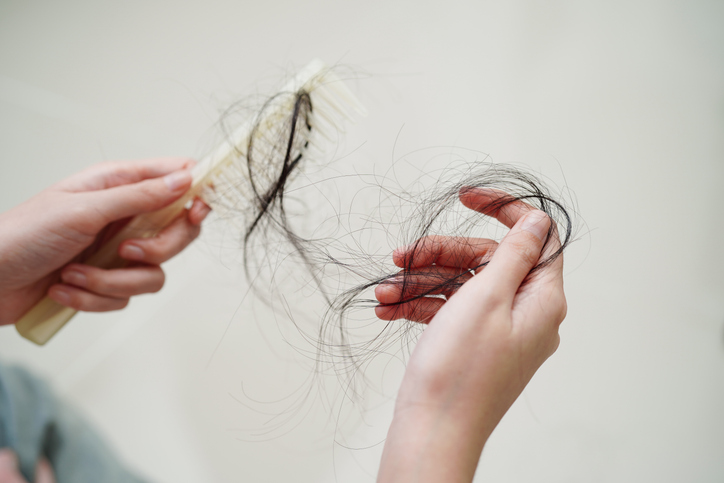
For many people, noticing a few extra hairs in the shower doesn’t seem like a big deal.
Then the hairline starts looking a little different. The part seems wider. The ponytail doesn’t feel as thick. Or maybe an old photograph makes you realize just how much your hair has changed over the last few years.
Hair loss can happen gradually, and it affects both men and women.












While Gameday Men’s Health may have “Men’s” in the name, our Solon clinic provides several services for women as well—including Platelet-Rich Plasma (PRP) hair restoration.
And unlike many cosmetic treatments, PRP starts with something your body already has: your own blood and platelets.










What Is PRP Hair Restoration?
Platelet-Rich Plasma therapy begins with a small blood draw, similar to having routine lab work performed.
That blood is processed to separate and concentrate the platelet-rich portion of the plasma. The PRP is then carefully injected into targeted areas of the scalp where hair has begun thinning.
Why platelets?
Most people associate platelets with blood clotting, but platelets also contain proteins and growth factors involved in the body’s normal healing and tissue-repair processes.
The concept behind PRP hair restoration is to deliver a concentrated amount of those platelets directly around existing hair follicles, where their growth factors may help support follicular activity and the hair-growth cycle.
Importantly, PRP isn’t artificial hair and it isn’t a hair transplant. It uses material obtained from the patient’s own blood.
What Does the Research Say?
PRP hair restoration has become an increasingly studied option for androgenetic alopecia, better known as male- or female-pattern hair loss.
A 2024 systematic review and meta-analysis of randomized clinical trials evaluated 14 studies involving 431 patients. Researchers found that PRP treatment was associated with an average improvement of approximately 27.5 hairs per square centimeter compared with placebo. The researchers also cautioned that the studies varied considerably in how PRP was prepared and administered, and they rated the overall quality of the evidence as low.
Other research has reached similar conclusions: PRP appears promising for improving hair density in appropriately selected patients, but treatment protocols and individual results can vary.
Research specifically involving women is encouraging as well. A systematic review examining PRP for female pattern hair loss included 42 studies and more than 1,500 cases, including 776 female participants. Researchers reported positive findings involving hair density while also emphasizing the need for larger, standardized clinical trials.
In other words, PRP isn’t a miracle cure for baldness—and a reputable medical clinic shouldn’t advertise it as one.
But there is legitimate scientific evidence suggesting PRP can be a useful treatment option for certain men and women experiencing thinning hair.
Why Starting Earlier Can Matter
One of the most important things to understand about hair restoration is that not all hair loss is the same.
PRP is generally intended to support existing hair follicles. That means someone noticing thinning hair may be a better candidate than someone who has had an area of complete baldness for many years.
That’s also why evaluation matters.
Hair loss can be influenced by genetics, age, hormonal changes, medications, stress, nutritional issues and certain medical conditions. Women may notice changes around menopause or other periods of hormonal transition, while men commonly experience progressive recession or thinning at the crown.
Before simply choosing a treatment because you saw it advertised online, it’s worth having a conversation about what may actually be contributing to the change.
Hair Restoration Is for Women, Too
There is still a misconception that significant hair thinning is primarily a men’s issue.
For women, it may simply look different.
Rather than developing the classic receding hairline many men experience, women may notice their part becoming wider, decreased density across the top of the scalp or a gradual reduction in overall volume.
That can be frustrating—especially when you’re otherwise healthy and don’t know why your hair has changed.
PRP gives appropriate female patients another nonsurgical option to discuss with a medical provider.
What Should You Expect?
PRP hair restoration is performed as an in-office procedure. Because the treatment uses the patient’s own blood, there is no donor tissue involved.
Treatment typically involves a series of sessions rather than one procedure.
The American Academy of Dermatology notes that PRP treatment commonly begins with monthly treatments for approximately three months, followed by maintenance treatments every three to six months. Individual treatment plans can differ based on the patient, the type and degree of hair loss, and the medical provider’s protocol.
And patience matters.
Hair grows in cycles. This isn’t a treatment where someone should expect to walk out of the office on Tuesday and have dramatically thicker hair by Friday. Changes are typically evaluated over a period of months.
PRP May Also Be Part of a Bigger Hair-Restoration Plan
Hair restoration doesn’t always have to be an either/or decision.
Depending on the individual, a provider may discuss PRP alongside other approaches to hair loss, including medications such as minoxidil or finasteride when medically appropriate.
In fact, research has examined combination approaches. A 2024 systematic review of randomized controlled trials found that studies evaluating PRP combined with minoxidil generally reported better hair-density outcomes than minoxidil alone, although the researchers also noted limitations in the quality of some of the available studies.
The takeaway is simple: hair loss treatment should be individualized.
What makes sense for a 35-year-old man beginning to notice thinning at the crown may be very different from what makes sense for a 52-year-old woman noticing progressive thinning through her part.
The Goal Is Simple: Know Your Options
Losing your hair isn’t dangerous in most cases, but that doesn’t mean it can’t affect how you feel about yourself.
For some people, hair loss doesn’t bother them at all. For others, it can significantly affect confidence and self-image.
Neither reaction is wrong.
What matters is knowing that options exist—and understanding which options are supported by evidence and appropriate for you.
At Gameday Men’s Health Solon, our approach is to start with a conversation. We provide PRP hair restoration for both men and women, with treatment recommendations based on the individual rather than a one-size-fits-all package.
If you’ve noticed your hairline changing, your part widening or your hair simply isn’t as full as it used to be, it may be worth finding out what options are available.
Sometimes the best time to talk about hair loss isn’t when the hair is already gone.
It’s when you first start noticing the change.
Learn More About PRP Hair Restoration
Gameday Men’s Health Solon
6200 SOM Center Rd., Suite D-26
Solon, OH 44139
440-201-4919
Serving Solon, Nordonia Hills and surrounding Northeast Ohio communities.
Real Team. Real Medicine. Real Life Solutions.
PRP results vary by individual. PRP is not appropriate for every type or degree of hair loss. Consultation with a qualified medical provider is recommended to determine the cause of hair loss and whether PRP or another treatment may be appropriate.
Frequently asked questions
1. What is PRP hair restoration?
It is an in office treatment that uses a concentrated portion of a patient’s own blood plasma, rich in platelets. The PRP is injected into areas of the scalp where hair is thinning.
2. Is PRP only for men?
No. Gameday Men’s Health Solon offers PRP hair restoration to both men and women. Women often notice a wider part or less volume instead of a receding hairline.
3. Is PRP a hair transplant?
No. PRP is not a transplant and does not involve donor tissue. It uses material from the patient’s own blood.
4. How many PRP sessions are typically needed?
The American Academy of Dermatology notes that treatment commonly starts with monthly sessions for about three months. Maintenance sessions every three to six months usually follow. Individual plans vary.
5. How soon will results show?
Hair grows in cycles, so changes are typically evaluated over a period of months. Results vary by person, and PRP is not right for every type of hair loss.
