




There comes a point when a lot of men start saying the same thing.
“I guess I’m just getting older.”
Maybe it’s taking longer to recover after a workout. Maybe those extra 15 pounds aren’t coming off like they used to. Maybe you’re falling asleep on the couch at 8:30, even though you haven’t done anything particularly exhausting that day.








Or maybe it’s something a little harder to talk about.
Your energy isn’t what it used to be. Your motivation has changed. Your sex drive isn’t quite the same. And somewhere along the way, you’ve started accepting those changes as a normal part of getting older.










But here’s a question worth asking:
What if age isn’t the whole story?
Getting older is inevitable. Feeling progressively worse without understanding why doesn’t have to be something you simply accept.
Your 30s: When the Changes Are Easy to Ignore
For many men, their 30s are some of the busiest years of their lives.
Careers are moving forward. Families are growing. Kids have practices, games, and activities. There’s a mortgage, a never-ending list of things around the house, and somehow fewer hours in the day than there used to be.
Exercise becomes something you try to fit in rather than something you make time for.
Sleep gets sacrificed. Meals become whatever is convenient. Stress becomes part of the daily routine.
And because you’re still relatively young, you don’t necessarily think about how those habits might affect your health ten or twenty years down the road.
But the body doesn’t wait until your 50th birthday to respond to lifestyle changes.
Poor sleep, physical inactivity, chronic stress, and excess body fat can influence energy, metabolic health, cardiovascular risk, and hormone regulation.
Testosterone levels can also begin changing during adulthood, although the rate and timing vary considerably between individuals.
That doesn’t mean every tired 35-year-old man has low testosterone.
It means that persistent changes in how you feel deserve more consideration than simply blaming your age.
Your 40s: When Your Body Starts Asking for More Attention
For some men, their 40s are when changes become harder to overlook.
The workouts that used to keep you in shape don’t seem to produce the same results.
You’re carrying more weight around your midsection. You may notice less muscle definition, even though your routine hasn’t changed dramatically.
You still get through the workday, but by the time you get home, there’s not much left in the tank.
And occasionally, you catch yourself wondering why you don’t feel like the same person you were ten years ago.
Some of these changes may reflect normal aging. Others may be influenced by sleep quality, nutrition, physical activity, medications, metabolic conditions, or hormonal changes.
Research has shown that testosterone levels are associated with several aspects of men’s health, including muscle mass, sexual function, and red blood cell production.
But testosterone is only one piece of a much larger picture.
For example, a man experiencing fatigue and weight gain might have low testosterone. He might also have obstructive sleep apnea, an underactive thyroid, depression, poorly controlled blood sugar, or simply a lifestyle that no longer supports his physical demands.
The symptoms may look similar. The appropriate treatments can be very different.
That’s why understanding what’s happening matters more than guessing.
Your 50s and Beyond: The Goal Shouldn’t Be to Feel 25 Again
By the time many men reach their 50s, they’ve started thinking differently about health.
It’s no longer necessarily about having the biggest arms at the gym or fitting into the same jeans they wore in college.
It’s about being able to do the things they enjoy.
Playing golf without feeling exhausted afterward.
Working in the yard without needing the rest of the weekend to recover.
Keeping up with the kids or grandkids.
Traveling, hiking, coaching, working, and enjoying time with a spouse or partner.
For some men, it’s simply about having enough energy left at the end of the day to enjoy life outside of work.
And that’s an important distinction.
Healthy aging isn’t about turning back the clock. It’s about maintaining the ability to participate in your own life.
Research consistently supports the importance of physical activity, resistance training, adequate sleep, and management of cardiovascular and metabolic risk factors as men age.
Medical evaluation can also help identify treatable conditions that might otherwise be dismissed as normal aging.
You may not be able to control the number of birthdays you’ve celebrated.
But there are meaningful steps you can take to influence your health in the years ahead.
What Does Testosterone Actually Have to Do With Aging?
Testosterone is an important hormone involved in several functions throughout the male body.
It contributes to sexual development and function, maintenance of muscle and bone, red blood cell production, and other physiological processes.
Testosterone levels can decline with age, but that decline is not identical for every man.
In fact, research from the European Male Ageing Study demonstrated that age-related testosterone changes are influenced by factors beyond chronological age, including obesity and overall health.
This is an important finding because it challenges the assumption that declining testosterone is simply an unavoidable consequence of getting older.
However, low testosterone should not be diagnosed based on symptoms alone.
The American Urological Association recommends diagnosing testosterone deficiency only when a patient has compatible symptoms or signs and consistently low testosterone levels, generally confirmed through two separate early-morning blood tests.
The Endocrine Society similarly recommends a careful clinical evaluation before diagnosing hypogonadism or considering testosterone treatment.
In other words, feeling tired doesn’t automatically mean you need testosterone therapy.
And having a testosterone level that falls within a particular laboratory range doesn’t automatically explain everything you’re experiencing.
The right starting point is understanding your symptoms, medical history, and laboratory results together.
Why Lifestyle Still Matters, Even When Hormones Are Involved
There’s a misconception that medical treatment and healthy lifestyle choices are somehow competing approaches.
They aren’t.
Even when a medical condition is identified, everyday habits can have a significant influence on overall health.
Consider sleep.
Adults generally need at least seven hours of sleep per night, yet many men routinely fall short because of work schedules, family responsibilities, or poor sleep habits.
Sleep disruption can affect alertness, mood, appetite regulation, and metabolic health.
Physical activity is another major factor.
The U.S. Department of Health and Human Services recommends that adults get at least 150 minutes of moderate-intensity aerobic activity each week, along with muscle-strengthening activities on at least two days.
Resistance training becomes particularly valuable with age because it helps preserve strength, muscle mass, and physical function.
Nutrition matters, too.
Maintaining a healthy body composition, consuming adequate protein, and managing conditions such as diabetes and high blood pressure can all contribute to better long-term health.
The point isn’t that every man needs to become a marathon runner or spend two hours a day in the gym.
It’s that small decisions made consistently over time can influence how well you function later in life.
And when lifestyle changes aren’t producing the expected results, that may be a reason to investigate further rather than give up.
What About Weight Gain, Energy, and Sexual Health?
One reason men’s health can be complicated is that many symptoms overlap.
Weight gain, reduced energy, changes in sexual function, and decreased physical performance can have multiple contributing factors.
For example, obesity is associated with lower testosterone levels in some men, but the relationship is complex.
Excess body fat can influence hormone regulation, while low testosterone in certain clinical circumstances can contribute to changes in body composition.
Erectile dysfunction is another example.
Although testosterone plays a role in sexual desire and function, erectile dysfunction is not always caused by low testosterone.
It can also be associated with cardiovascular disease, diabetes, medications, psychological factors, and other health conditions.
In fact, erectile dysfunction can sometimes be an early indicator of underlying cardiovascular risk.
That’s one reason men shouldn’t feel embarrassed about bringing these concerns to a medical provider.
What seems like an isolated problem may be an opportunity to identify something more important.
When Should You Consider Getting Checked?
Not every change requires medical treatment.
Feeling tired after a long week, gaining a few pounds during the holidays, or needing an extra recovery day after a difficult workout doesn’t automatically indicate a medical problem.
But certain patterns are worth discussing with a qualified healthcare professional.
These may include:
- Persistent fatigue that doesn’t improve with adequate rest
- Unexplained changes in weight or body composition
- Reduced sexual desire or changes in erectile function
- Loss of strength or muscle mass
- Difficulty recovering from normal physical activity
- Changes in mood, motivation, or concentration
- Sleep problems that affect daily functioning
The goal isn’t to turn normal aging into a medical diagnosis.
It’s to recognize when changes are persistent enough to warrant a closer look.
A thoughtful evaluation may include reviewing medications, sleep habits, medical history, cardiovascular risk factors, and laboratory testing when appropriate.
Sometimes the answer is a lifestyle adjustment.
Sometimes it’s treatment for an underlying medical condition.
And sometimes hormone evaluation identifies a legitimate issue that deserves further discussion.
The important part is not assuming you already know the answer.
Your Health at 60 Starts With Decisions You Make at 30, 40, and 50
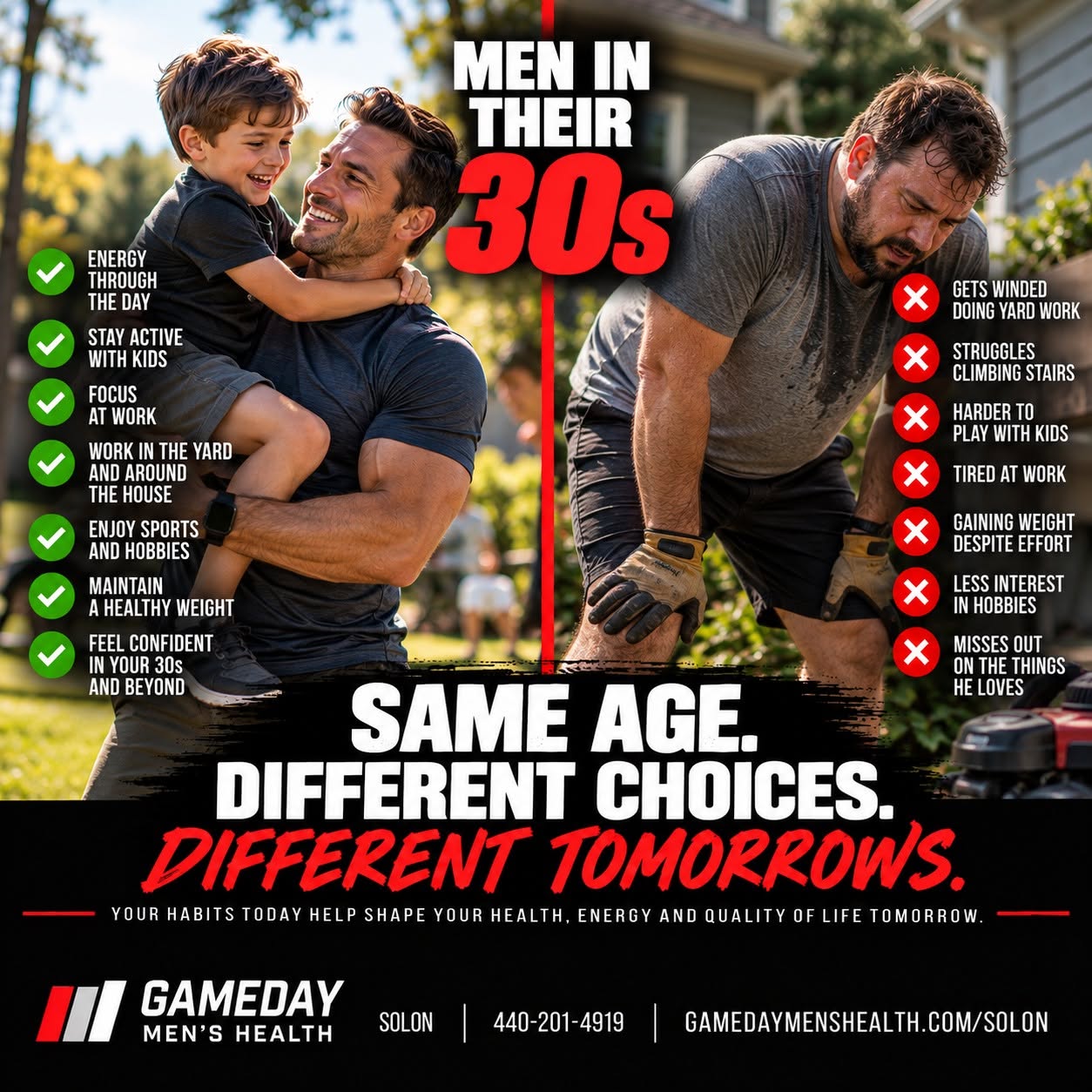
Think about two men who are the same age.
Both are 45 years old.
One prioritizes sleep, stays reasonably active, manages his weight, and follows up on health concerns when they arise.
The other consistently puts his health last, ignores persistent symptoms, and assumes he’ll deal with everything when he gets older.
Their health outcomes aren’t guaranteed to be different. Genetics, medical conditions, environment, and other factors still matter.
But their daily decisions can influence their long-term risk and physical function.
That’s the bigger message.
You don’t have to be perfect.
You don’t have to eat chicken and broccoli seven days a week.
And you certainly don’t have to give up everything you enjoy.
But paying attention to your health today can make a meaningful difference in how you’re able to enjoy tomorrow.
Getting Older Is Normal. Ignoring Your Health Doesn’t Have to Be.
At Gameday Men’s Health Solon, we believe men’s health should begin with education, honest conversations, and an understanding of the individual.
Our clinic provides evaluations for testosterone deficiency and offers services addressing weight management, sexual health, and other aspects of wellness.
Not every man who visits our clinic needs testosterone therapy.
Not every symptom is hormonal.
And not every health concern requires medication.
Sometimes the most valuable thing a man can do is stop guessing about why he feels different and start asking the right questions.
Whether you’re 32 and noticing changes in your energy, 45 and struggling with weight management, or 58 and wanting to stay active for the next twenty years, understanding your health is a worthwhile investment.
Because the goal isn’t to feel like you’re 25 again.
It’s to make sure the years ahead are years you can actually enjoy.
Take the First Step Toward Understanding Your Health
https://gamedaymenshealth.com/solon-oh
Serving Solon, Twinsburg, Macedonia, Northfield, Hudson, Aurora, Bainbridge, Chagrin Falls, and surrounding Northeast Ohio communities.
Real Team. Real Medicine. Real Life Solutions.
Care guided by licensed medical professionals.
This article is intended for general educational purposes and does not replace individualized medical advice. Fatigue, weight changes, sexual dysfunction, and other symptoms can have multiple causes. Testosterone therapy is appropriate only for certain patients with clinically confirmed testosterone deficiency and requires evaluation of potential risks, benefits, and contraindications. Individual results and treatment recommendations vary.
