



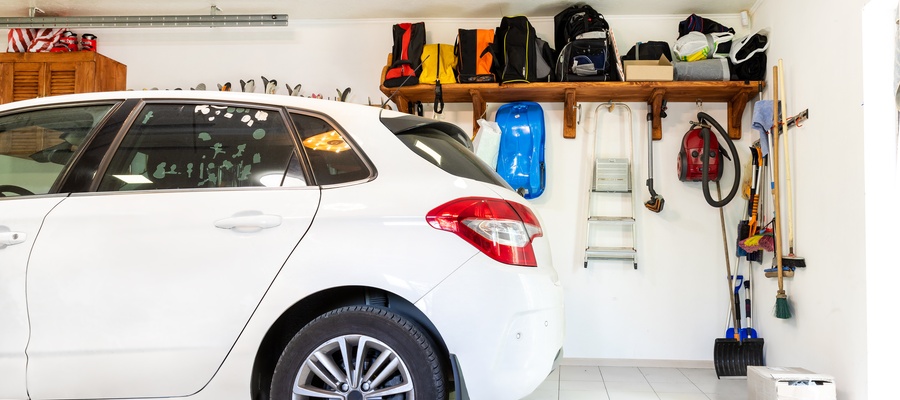
Holiday decorations share space with a lawn mower, paint supplies, and a car. While the garage holds a vast collection of items, the indoor area isn’t as protected as other rooms in the house. Temperature swings, poor air circulation, and moisture can slowly tear away at each item in the garage. To protect your belongings from damage, you’ll need to implement a few garage improvements that will protect your belongings.
Install a Moisture Barrier
Concrete may appear solid, but water vapor is relentless. It can travel through a slab or foundation wall. As a result, cardboard softens, and metal tools develop rust.
A moisture barrier limits vapor movement before it reaches belongings. Some homeowners choose a membrane beneath new flooring, while others apply a moisture-resistant coating over prepared concrete. Wall systems may use a separate barrier when dampness enters through masonry.












However, keep in mind that a barrier won’t solve a roof leak or poor drainage beside the foundation. You have to find the source of the issue first. Once you repair the root cause, the moisture barrier will function properly.
Add Garage Door Insulation
The garage door covers a large exterior opening. Thin panels let summer heat and winter cold move into the room with little resistance. Those shifts affect batteries and paint because both products respond poorly to extreme temperatures.










There are several purposes for garage door insulation, but temperature regulation is one of the most valuable benefits. The insulated panels slow heat transfer and keep the interior surface from becoming bitterly cold during winter. With a stable surface temperature, condensation near the door is less likely to occur.
Compare R-Values
R-value is a measurement of how well a material resists the transfer of heat. In simple terms, it tells you how effective insulation is at slowing down heat from moving through it. The higher the R-value, the better the material is at keeping warm air in during winter and hot air out during summer.
For most garage door and wall applications, homeowners commonly see R-values ranging from R-13 to R-19. For enhanced energy efficiency, high options like R-30 or R-38 are common options for ceilings or thick wall assemblies. Choosing the right R-value depends on your preferred level of temperature stability.
Replace Worn Weatherstripping
Weatherstripping is a flexible sealing material designed to close the small gaps around garage doors and entry doors. Its job is to block outside air, moisture, dust, and pests from slipping through the narrow spaces where the door meets the frame or floor. By creating a tight seal, it maintains stable indoor conditions.
There are several materials used for weatherstripping. Rubber and vinyl are widely used for bottom seals because of their flexibility. They establish a strong barrier against water and air movement.
Foam tape is commonly applied along the side and top door frames where a compressible seal is needed. For heavy-duty applications, silicone and reinforced rubber options offer substantial durability by resisting temperature fluctuations.
Improve Garage Airflow
Stale air tends to hang around in a garage and brings moisture and strong odors with it. Fabric bins start to smell musty, and wooden furniture begins to swell or warp in damp conditions. That’s why airflow is important in garages; it keeps humid air moving before substances have the chance to settle on any objects.
Passive vents are openings that allow air to flow naturally in and out of a space without the use of mechanical fans or power. Install passive vents on opposite walls of the garage—placing one set high near the roofline and another lower on the opposite side—to encourage steady cross-ventilation.
If that option isn’t possible, consider an exhaust fan. The fan is a mechanical device that removes stale, humid, or warm air from a space and pushes it outside. It works by pulling indoor air out of the garage and replacing it with fresher air from outside, helping improve ventilation and reduce moisture buildup.
Add a Garage Dehumidifier
Some garages stay damp no matter how much you improve airflow, and that lingering moisture can quietly damage your belongings. High humidity causes cardboard boxes to weaken, metal tools to rust, and wooden furniture to swell or warp over time. Even fabrics start to feel musty when moisture hangs in the air for too long. A dehumidifier tackles that problem head-on by pulling excess water out of the air.
Once you understand how much humidity affects your storage, it becomes clear why this upgrade makes such a difference. Instead of letting moisture slowly break things down, a dehumidifier helps you create a stable, dry space where your belongings actually last longer.
Find the Right Unit
You’ll find a few different types of dehumidifiers, and each one works a little differently. Portable units work well for most standard garages because you can move them as needed. Desiccant dehumidifiers handle cold temperatures well. On the other hand, refrigerant models perform best in warm conditions since they remove a large amount of moisture quickly.
When you choose a unit, think about your garage size and the typical climate in your area. A small unit won’t keep up in a large, damp space, while an oversized one may cycle unnecessarily in a smaller garage. Many standard models also struggle when temperatures drop, so cold-weather or desiccant options often work better in unheated garages.
Consider the Dehumidifier’s Placement
To get the best results, place the dehumidifier where air can circulate freely and let it run consistently during humid months. A built-in or separate hygrometer helps you keep an eye on moisture levels so you know when conditions stay in a safe range. Once you dial it in, a dehumidifier becomes a simple, effective method for protecting your stored belongings.
Raise Storage Off the Floor
Cardboard boxes don’t hold up well against damp concrete. A small leak can soak through the bottom before anyone notices a problem. Once moisture seeps into clothing or paper items inside the box, stains and mildew are sure to follow.
Installing shelves in the garage creates the distance your belongings need to stay safe from moisture. For tight spaces, wall-mounted shelves are beneficial. Freestanding units are ideal because they offer flexible storage.
Keep the lowest shelf several inches above the concrete so minor water intrusion won’t reach the containers. This small gap helps protect stored items from unexpected moisture after heavy rain or minor leaks. It’s a simple adjustment that adds an extra layer of protection to everything you store in the garage.
Add Overhead Storage Racks
Another efficient way to keep items away from the floor is to install ceiling racks. Instead of letting the ceiling space go to waste, use it to keep seasonal decor, camping gear, and other items you don’t reach for every day safe.
These racks work best when you think about what you plan to store and how often you’ll need to access it. Be sure to consider your garage size to ensure that the racks don’t hang too low or interfere with the door’s operation. Once everything is in place, you get a convenient storage zone that keeps your belongings out of harm’s way.
Upgrade Your Garage To Safeguard Your Belongings
When excess moisture and extreme temperature swings creep into the garage, each stored item is at risk. A little condensation on a humid day can lead to rust on tools, mildew on stored keepsakes, or damage to a car that sits parked for long stretches. Heat waves and freezing nights cause metals to expand and contract, gradually wearing them down. Implementing a few of these garage improvements, from insulation to improved airflow, will protect each of your belongings.
